 GET QUOTE
Choosing a Shape for Your Metal Raised Garden Bed
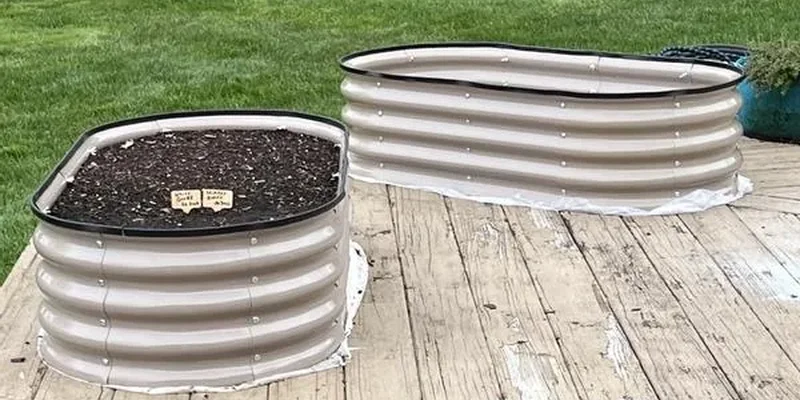
The outline of a metal raised garden bed affects more than the appearance of a garden. It changes where you can stand, how you reach the middle and how much room remains for paths. Compare footprints on the ground before deciding which shape looks best in a photograph.
Start with access to the planting area
University of Minnesota Extension recommends matching bed width to comfortable arm reach so the centre can be tended without stepping into the soil. This is a useful starting point for any outline, including a curved or multi-zone metal bed. Read its raised-bed guidance.
Mark the proposed shape with a hose or another temporary guide. Stand where you expect to weed, plant and harvest. If one side will be against a fence, assess reach from the accessible side rather than treating it as a bed with access all around.
Compare rounded and straight sides
An oval outline creates curved ends that can suit an informal layout. A rectangular outline is straightforward to align with paving or a straight boundary. Neither description tells you the usable planting area: request internal dimensions and account for the actual corner shape.
For a narrow garden, draw the surrounding paths as well as the bed. The widest point of a curved bed may control the remaining passage. For a series of rectangular beds, inspect the spaces at the ends where a person must turn or carry tools.
Check the purpose of a shaped layout
A U-shaped or multi-zone arrangement may introduce access points within the overall footprint. Examine those openings carefully. They need to work for the intended gardener and maintenance tools, rather than simply looking spacious in an overhead drawing.
Ask whether the quoted kit assembles into one fixed configuration or several approved configurations. Do not assume that curved and straight panels can be rearranged freely. Bracing, hole patterns and the supplied hardware may be specific to the intended assembly.
Keep planting and purchasing decisions together
Draw the mature plant positions on the layout, leaving space to reach supports and irrigation. A shape chosen around seedlings may feel crowded once foliage develops. For retail buyers, a simple plan showing the assembled outline can help customers understand a product more accurately than dimensions alone.
Compare the shapes in the SeeYes Garden metal raised bed collection using drawings for the exact models under consideration. Check the finished edge, panel connections and included supports alongside the outline.
Before ordering, send a sketch of the available space, indicating fixed boundaries and access sides. Include the intended planting use and quantity. That gives the team a basis for discussing a suitable configuration without assuming that the largest bed is automatically the most useful one.