 GET QUOTE
Plan a Small Patio with Metal Privacy Screens
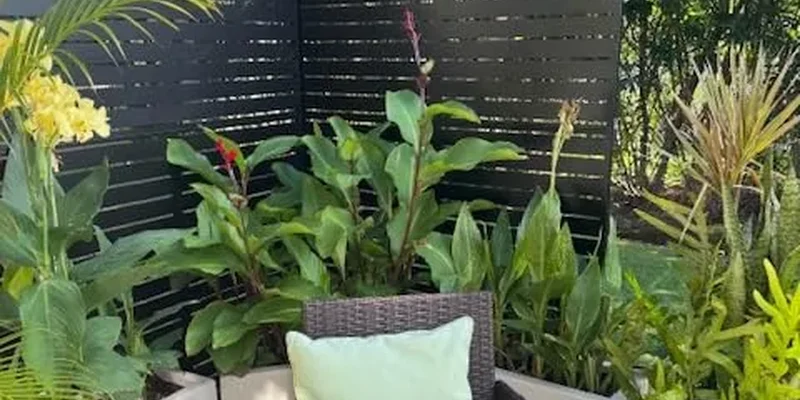
On a compact patio, a privacy screen takes up more room than its panel thickness suggests. Feet, planter bases, chair movement and cleaning access all belong in the layout. Measuring those details first can prevent a useful divider from becoming an everyday obstacle.
Draw the space as it is used
Sketch the patio, including doors, steps, drains and permanent furniture. Add the space occupied by a chair when someone gets up, not just when it is tucked under the table. Walk the route from the house to the garden carrying a tray or watering can and note where the route narrows.
Now mark the view that needs screening. A short divider beside the seating area may answer the problem without enclosing the entire perimeter. Check the view from both ends of the table and from inside the house before committing to a position.
Measure the whole footprint
For a freestanding metal screen, request a drawing showing the panel, feet and any fixing plates. For a planter screen, include the planter depth. These dimensions matter more to circulation than a front elevation alone.
Do not position a foot where a chair leg normally travels. Leave enough room to inspect and clean the base. If a screen sits beside a door, verify the door’s complete swing, handle clearance and the space needed to stand while opening it.
For example, a hypothetical 3-metre patio with a 0.4-metre-deep planter does not retain a full 3 metres for furniture. Subtract the planter footprint before laying out the chairs. This is a planning example, not a specification for any particular product.
Use a planter only if it serves the plan
A screen with an integrated planting space combines two functions in one position. It also introduces watering, drainage and plant maintenance. Decide where water will leave the planter and whether someone can reach the plants without moving furniture.
The geometric metal screen planter illustrates this combined format. Confirm the chosen version’s dimensions, planting arrangement and fixing requirements before ordering. A planter base should not be treated as proof that anchoring is unnecessary.
Keep the layout workable after installation
Consider where a hose will run and where fallen leaves will collect. A narrow gap behind a panel can be difficult to reach once furniture and plants are in place. Ask whether the intended installation leaves access to fasteners that may need inspection.
Moveable furniture helps you test a layout; it does not make the screen itself safe to move while filled or installed. Follow the handling instructions for the selected model and settle its final position before filling an integrated planter.
Browse the metal screen collection, then send a dimensioned patio sketch with the location of doors and seating. A clear sketch makes it easier to compare a single panel, a corner arrangement and a planter screen on the space each will actually occupy.